In Yugoslavia, captured German soldiers and members of ethnic German civilian communities faced similarly harsh conditions.
They were often held in the same camps, where they faced hunger, cold, severe deprivation, forced labour, torture and violence.
The exact number of German prisoners in Yugoslavia, most of whom had surrendered there, is difficult to establish; estimates range from 200,000 to 240,000.
According to the estimates cited here, about 80,000 prisoners were killed after capture. Many members of the “Prinz Eugen” Division, composed largely of ethnic Germans from the Banat, were killed after being taken prisoner.
On 8 May 1945, the date of Germany’s surrender, around 150,000 German soldiers were still near the Slovenian border. British forces refused to accept these troops into Carinthia.
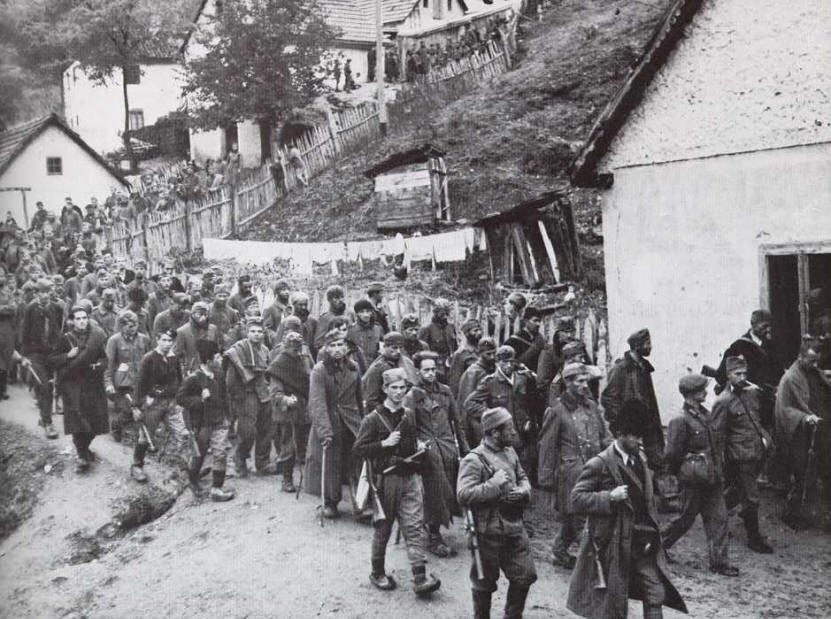
German POWs in Serbia
"Punitive marches"
After disarmament, they began their march into captivity on 16 May 1945, heading towards Cilli, St Veith bei Laibach, Esseg, Belgrade and Pančevo.
During these daily forced marches of 30–40 km, prisoners received no food. Many never reached their destination; those too exhausted to continue were shot by guards.
An estimated 10,000 prisoners died on the so-called “punitive marches”. The survivors were taken to labour camps.
The largest camps held between 4,000 and 5,000 men. Camp No. 5 in Sarajevo held about 4,000 prisoners, while the officers’ camp at Vršac (Werschetz) held around 3,500.
Prisoners were used as forced labour in agriculture, forestry, mining, road and railway construction, and industry. Conditions were extremely harsh.
Work in copper mines and mine clearance was particularly dangerous, while malnutrition, disease and physical exhaustion claimed many additional victims.
Torture, show trials and mass executions
At the same time, thousands of prisoners were convicted in show trials and executed by firing squads on the basis of confessions extracted under torture.
Violence, hunger and appalling sanitary conditions also prevailed in the camps.
The camps listed in the source include:
Rudolsgnad
Groß Kikinda
Molydorf
Birndorf
Schönhausen
Kerndia
Abthausen
Altwiesen
Pancevo
Deutsch-Ellmer
Deutsch-Etschka
Ernsthausen
Eugendorf
Eugenwall
Filipsdorf
Groß Betscherek
Gutacker
Hanfhausen
Josefsdorf
Kubin
Lazarfeld
Modosch
Neudorf
Neuhatzfeld
Neusatz
Neuzerne
Pardab
Petersheim
Plankenburg
Rotweil
Ruma
Sartscha
Semlin
Schomburg
Schorfeld
Sonnhag
Stefansfeld
Tenje
Torschau
Walpach
Weidenheim
Weißkirchen
Wolfsburg
Of the approximately 194,000 Wehrmacht soldiers who entered Yugoslav captivity, the figures presented here state that about half died, many under extremely harsh conditions.